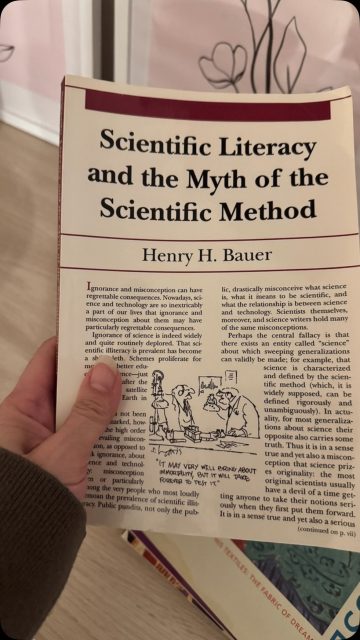
I stumbled upon this book from my doctoral years today: Scientific Literacy and the Myth of the Scientific Method, by Henry H. Bauer (1992).
And it made me reflect on something that has been bothering me about the way we approach AI literacy.
More than 30 years ago, Bauer was already challenging the idea that science could be understood through a universal method, a sequence of steps that somehow captures how scientific knowledge is produced.
Fast forward to today, and I wonder whether we’re making a similar mistake with AI.
We’re developing AI literacy frameworks, competency models, guidelines, checklists, and training programs. All important efforts.
But I keep coming back to a question: Are we trying to make people more capable of navigating complexity, or are we trying to make complexity manageable by turning it into a set of competencies we can teach and measure?
And who gets to decide what counts as being AI literate?
The people developing the technology? The institutions adopting it? The researchers studying it? The organizations defining the competencies their workforce should acquire?
These are not neutral decisions. What we choose to include in a literacy framework, and what we leave out, shapes what people are encouraged to understand, question, accept, or challenge.
I also wonder whether, in our rush to define what everyone should know about AI, we’re paying enough attention to what different people actually need to be able to do in the situations they encounter.
Perhaps the most important question is not whether someone meets our definition of AI literacy, but whose interests that definition serves, what assumptions it carries, and what possibilities it opens or closes.
A book from 1992, reminding me to question not only what we teach, but the frameworks through which we decide what is worth teaching.
2 jours ago